PROJECT 02NEUROSCIENCE RESEARCH & MEDICAL IMAGING
Penfield.
Instruments to observe, understand, model and simulate the human brain, built in the open.
- STACK
- Next.js, React, strict TypeScript, Tailwind, Framer Motion
- RENDERING
- Three.js, on-demand, STL-derived GLB models
- PRODUCTS
- Twelve planned across five divisions
- PUBLIC
- penfield.online, plus a sample Penfield Cognitive assessment
- DATA
- Synthetic, and labelled as such
Overview
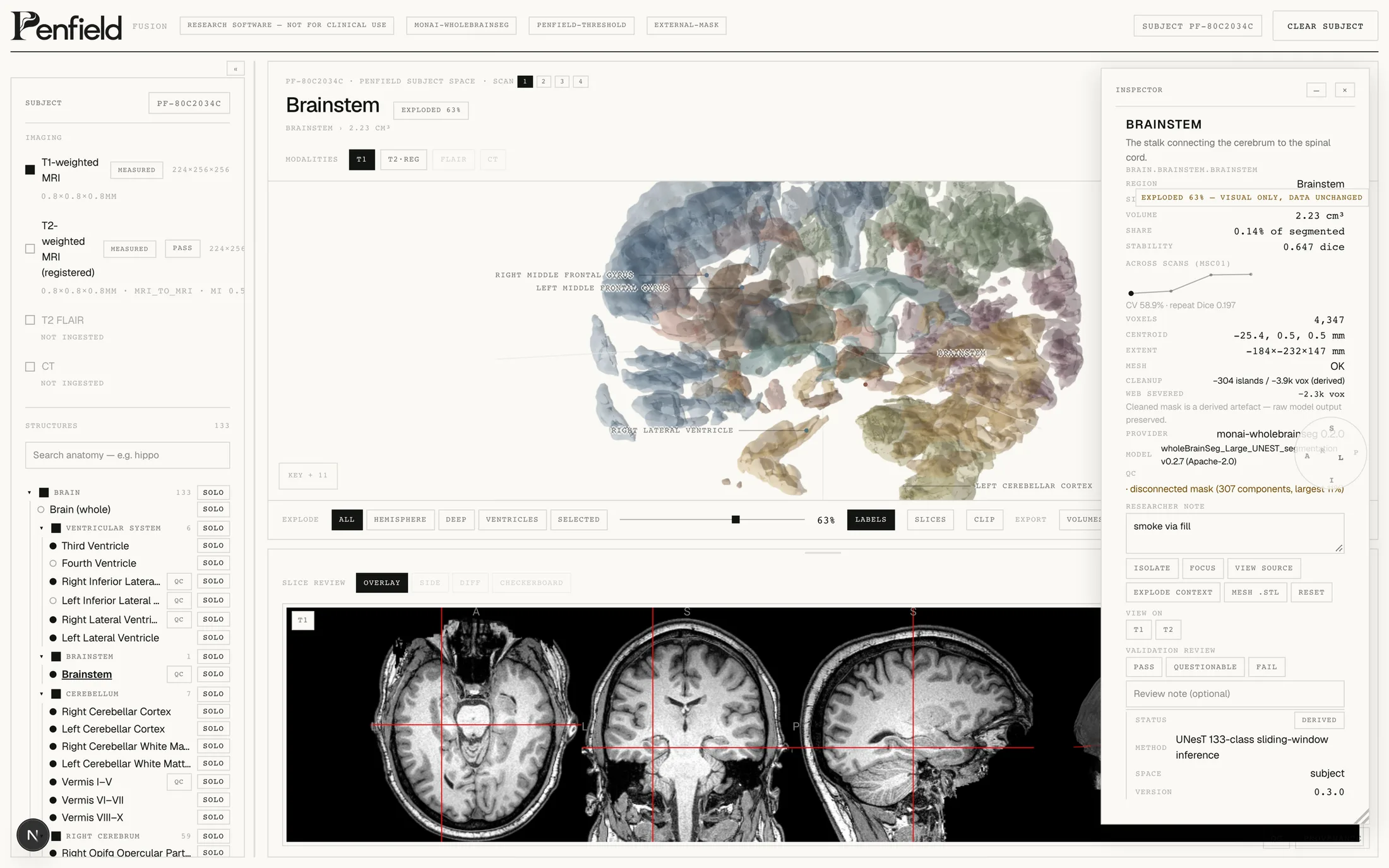
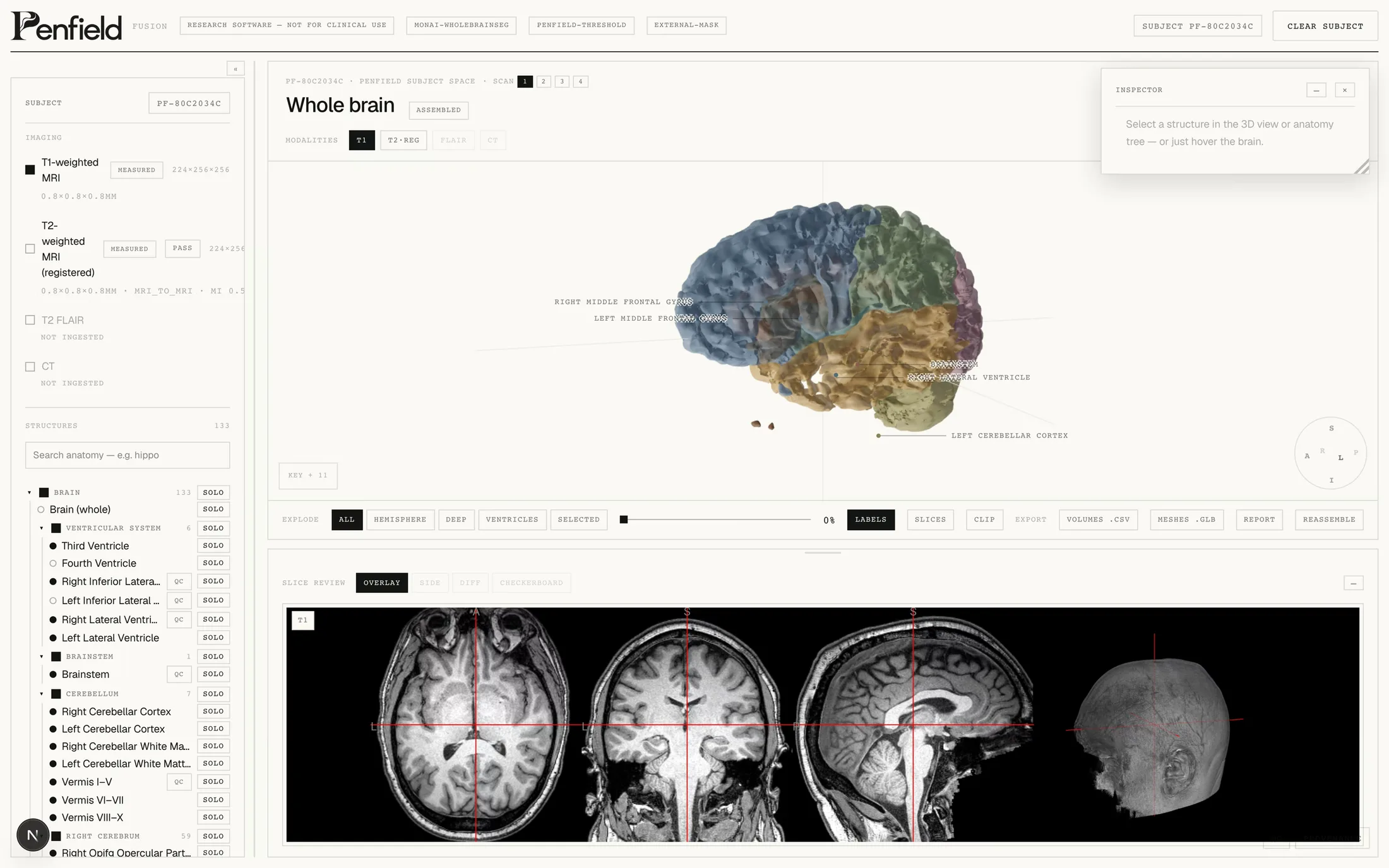
Penfield is a research and software effort in medical imaging. Its first instrument, Penfield Fusion, ingests MRI scans, assembles anatomical structures, and renders an explorable three-dimensional model of a brain, alongside the slice review, reporting and validation tooling around it.
The product family is organised into five divisions: Observe & Understand (Fusion, Findings, Reference, Cognitive, Compound), Model (Atlas, Model), Simulate (Dynamics, Response), Repair (Plan), and Instruments (Acquire, Console). Penfield Core is the shared internal infrastructure underneath them.
Why it exists
Brains are hard to measure. Scans are siloed by format and institution, few measurements reproduce cleanly, and the tooling gap between research and the clinic is enormous. Penfield exists to build the instruments that close it, built properly, honestly, and in the open before asking anyone to believe in them.
Approach
Local-first, reproducible, honest, published. Every claim on the project site is measured or clearly labelled synthetic. The software is designed like an instrument: precise typography, exact figures, and no decoration that doesn't carry information.
The brain visuals start from real geometry rather than procedural shapes: supplied STL models (a 4,894-strut wireframe and a 93,260-triangle low-poly) are converted through a build pipeline into lightweight GLB renders, drawn on demand with Three.js. The MRI panel scrubs through a real T1 sequence packed into a slice atlas. Penfield Cognitive is a public sample assessment with unscored items.
Status
In development, with research and instrument builds ongoing. Reference data, MRI illustrations and simulation signals shown are synthetic; nothing here is a diagnostic tool.
ENGINEERING & RESULTS
THE HARD PART
A brain that fits in a browser
The supplied STL models are far too heavy to ship raw: a 93,260-triangle low-poly and a 4,894-strut wireframe. A build pipeline converts them to lightweight GLB and the viewer renders on demand, so the page never pays for a mesh nobody is looking at.
The MRI panel had the same constraint in a different shape: scrubbing a real T1 sequence means hundreds of slices. Packing the sequence into a texture atlas keeps scrubbing instant instead of hundreds of network fetches.
- LIVE
- penfield.online
- PUBLIC DEMO
- Sample Penfield Cognitive assessment, anyone can take it
- HONESTY
- Every figure measured or labelled synthetic
- SCOPE
- Twelve products mapped across five divisions
VERIFIED