PROJECT 06MEET STRANGERS. PLAY TOGETHER.
LetsMingle.
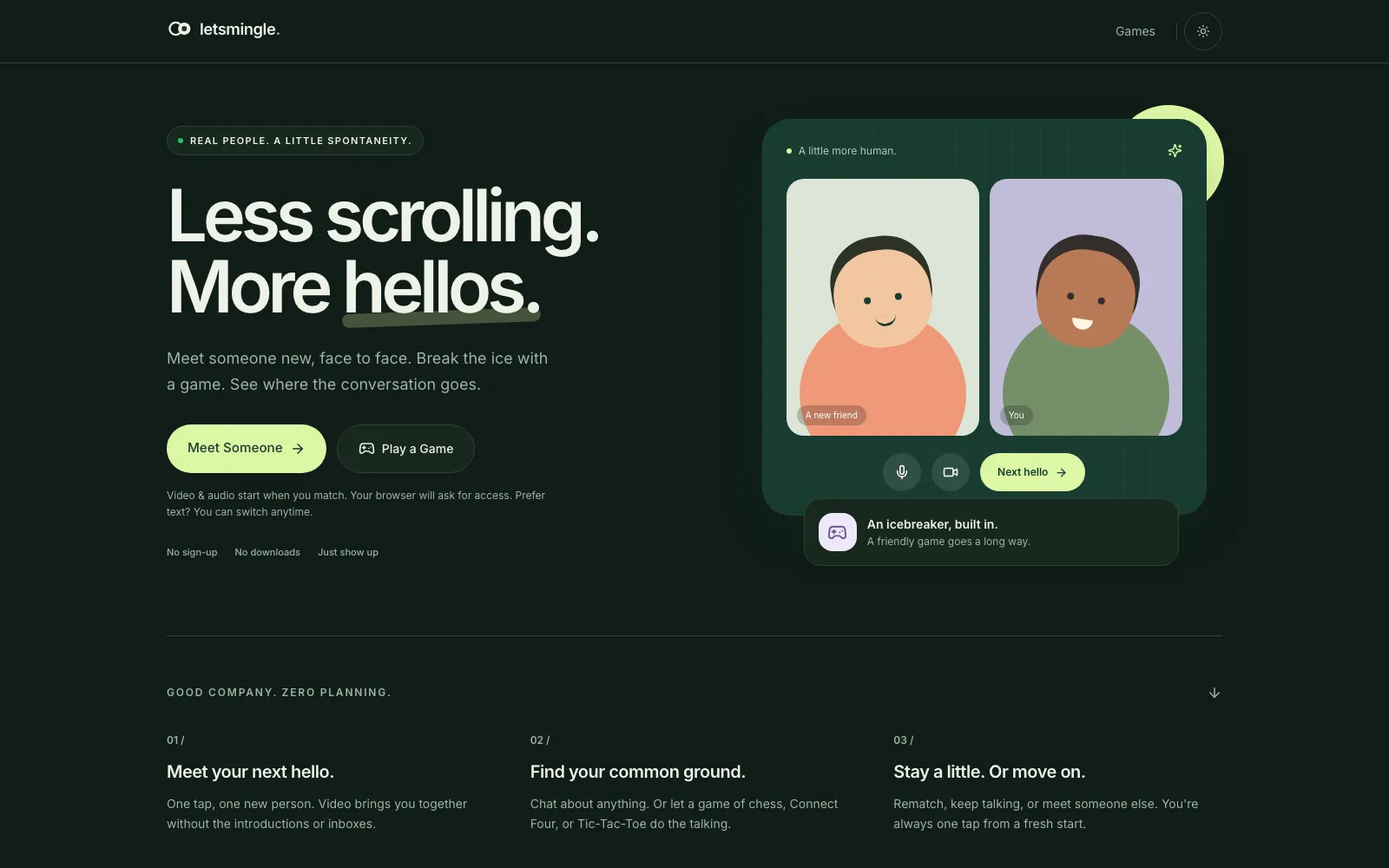
Random video chat that starts with a game, not an awkward hello. Anonymous, instant, no accounts.
- STACK
- Next.js 15 web plus Socket.IO realtime, pnpm monorepo
- AUTH
- Anonymous JWT guest sessions, no accounts
- GAMES
- 11 playable, server-authoritative
- VIDEO
- WebRTC, scoped signaling, text fallback
- CHAT
- In-memory only, nothing persisted
- DATA
- Prisma, SQLite dev, Postgres-ready
- TESTS
- Vitest, two-socket e2e, Playwright
Overview
LetsMingle is an Omegle-inspired social gaming platform: random matchmaking, real-time chat and server-authoritative multiplayer games in one conversation. You show up as a guest, get matched, and a game of chess, Connect Four or Tic-Tac-Toe does the introductions.
It runs as a pnpm monorepo: a Next.js web app for the interface and guest sessions, a Socket.IO service that owns matchmaking, chat, challenges and game state, and shared packages that keep the socket contract and game rules identical on both sides.
Why it exists
Meeting strangers online is usually an empty text box and an awkward first message. A shared game gives the conversation somewhere to go from the first second: make a move, talk about it, rematch or move on.
Approach
The realtime service is the single authority. Matchmaking is a FIFO ticket scan with language, game and mode preferences, queue position and ETA pushed as it scans. Game sessions run a GameDefinition per game: validate the turn, apply the rules, broadcast the per-seat view.
Privacy is structural, not a policy page. Guest sessions are anonymous JWTs, chat is in-memory with a rate limit and a cap, and guest matches write nothing to the database. The account and moderation tables exist in the schema for later, but the bare-bones build deliberately does not use them.
Status
Live at letsmingle.site. This is the bare-bones build: anonymous guests only, no accounts, no profiles, no moderation tooling. Redis-backed queues and Postgres are ready in the infrastructure layer when the account side gets switched on.
ENGINEERING & RESULTS
THE HARD PART
Strangers can't be trusted, so the server decides everything
Clients never decide outcomes. They emit intents: join a queue, send a chat, play a move. The realtime service validates everything against the rules and broadcasts authoritative state back, so a modified client cannot cheat a chess position or double-assign a match.
The other hard constraint is privacy by architecture rather than policy: guest sessions are signed JWTs with no user row behind them, chat lives only in memory, and matches are ephemeral by default. There is nothing to leak because nothing is kept.
- LIVE
- letsmingle.site
- VERIFIED
- Two-socket e2e: match, chat, challenge, game, rematch, video signals
- TESTED
- Vitest across packages plus a Playwright two-browser spec
- PLAYABLE
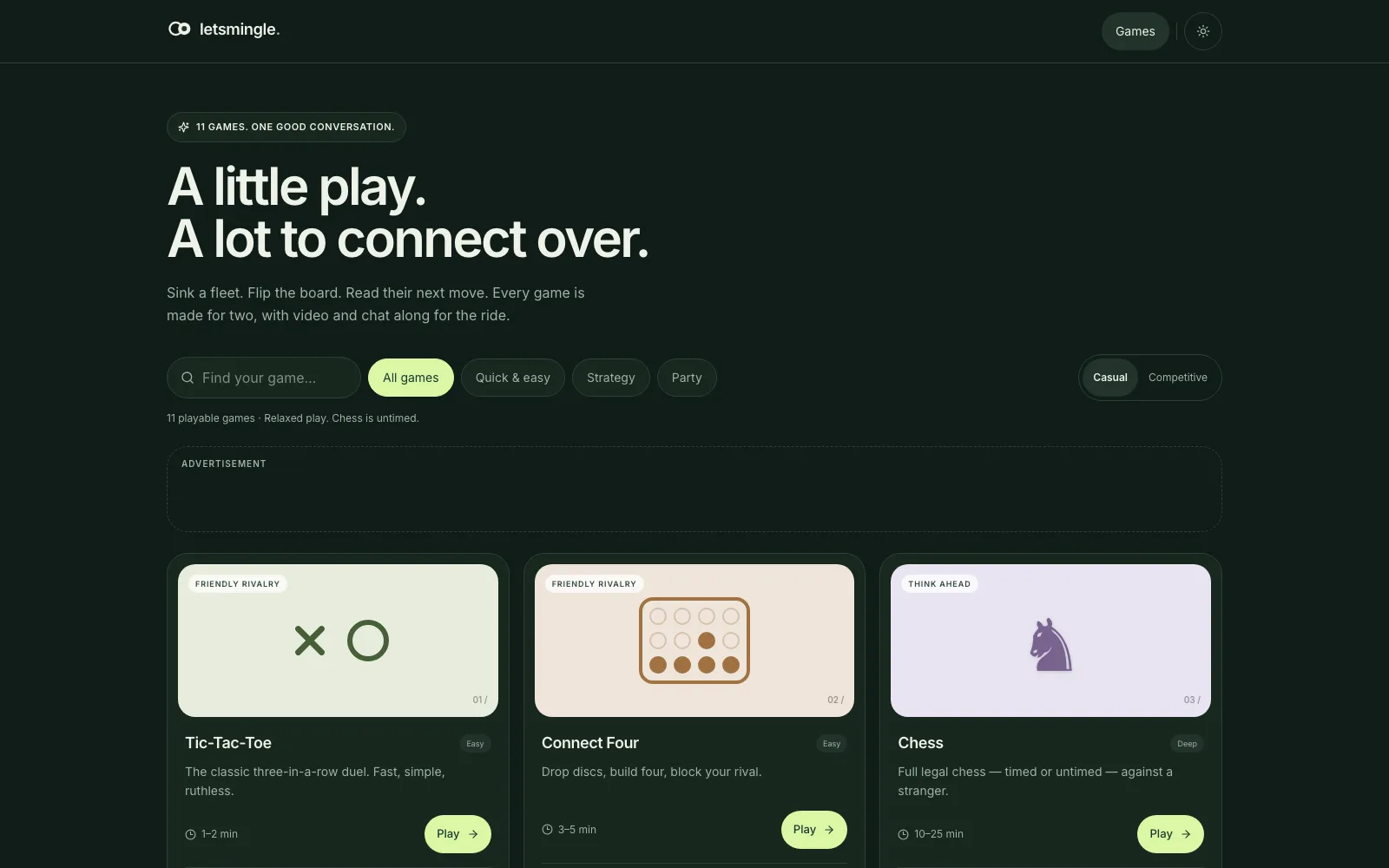
- 11 games, chess timed or untimed
VERIFIED